
When your "Good Writing" doesn’t create conversation

I want to open this with a question. Why do you want people to comment on you work? Or why do you think it is desirable for people to comment on you work? What is the actual benefit aside from perceived status?
There is an implicit assumption here that comments are a sign of quality and progress. But if that were true why is it that some of the most beautifully written pieces receive almost no comments while some seemingly mediocre piece of content wracks up hundreds?
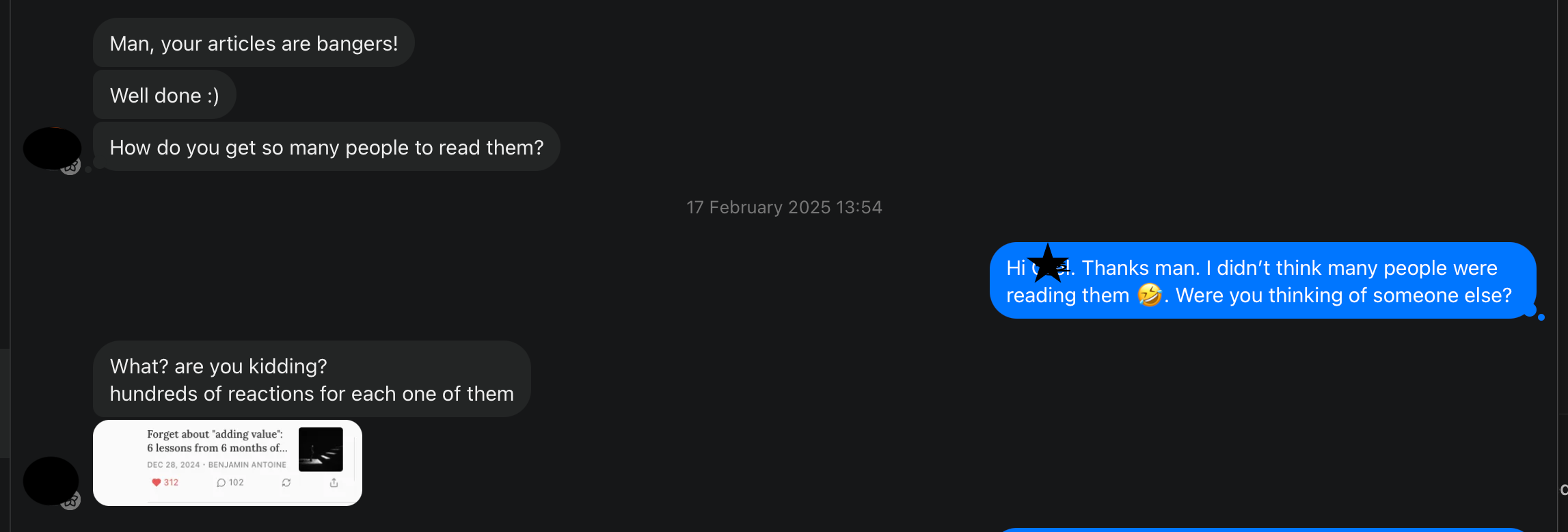
A year ago I had a little exchange in the DM’s with someone who has built a business around these kind of assumptions…although that wasn’t the case when he DM’d me.
He too was struggling with this question of how to “get people to comment” which is why I see this as one of the most fundamentally misunderstood ideas in this space.
(As a side note, I increasingly place less and less weight on comments as A.I automations have flooded into Substack.)
Comments, in general are triggered by emotions not the intellect. People don’t comment because the writing is good but because they disagree, feel seen, feel challenged, feel understood or have a story to add.
Information Doesn’t Create Conversation
This is where I spent a lot of time in confusion.
I assumed that if something is useful enough, insightful enough or detailed enough then people will naturally want to discuss it.
In reality, information is often consumed in silence.
Think about the last time you watched a tutorial on YouTube, read an instruction manual or searched for an answer to a technical problem. Once you had the answer, the interaction was complete. There was nothing left to add.
The same thing happens with writing.
A well-structured article that thoroughly explains a topic can be incredibly valuable whilst simultaneously generating no conversation. The reader arrives with a question, receives an answer and then moves on with their day.
Conversation emerges under very different conditions, essentially when something remains unresolved.
Some kind of tension or disagreement, or a perspective that challenges an existing belief. A feeling that someone has finally articulated something you have been struggling to put into words yourself.
This is one of the reasons personal stories tend to generate so much discussion. People are not simply reacting to the information contained within them. They are reacting to the meaning behind it. They begin comparing it to their own experiences, drawing connections and filling in the gaps with stories of their own.
Therefore the comment section is often an attempt to complete something. People want to add context and to share a personal experience, and in some cases they want to continue a conversation that the piece itself has already started.
What you might not want to admit…
I think there is another reason many writers struggle to generate meaningful conversation and it has very little to do with their writing ability.
They are still protecting themselves. Many people, myself included, start out scared and so temper their views and overthink the ideas they want to share.
They soften their opinions to appeal to a wider audience. Or they edit out all the controversial and confrontational parts to the point where all the actually interesting stuff has been removed…(A.I does this by default so that is something to watch out for).
While I understand that it can be quite distressing to be misunderstood or mischaracterised the alternative is to wrap your convictions in so many caveats and disclaimers that by the time the reader reaches the end, there is nothing left to react to.
The result is often balanced and neutral writing which is perfectly sensible and perfectly forgettable.
This is especially common amongst intelligent people because they can see multiple sides of an argument. They understand nuance and appreciate complexity. These are incredibly valuable traits, but they can also become a form of self-protection.
The reader finishes the piece agreeing with everything and feeling nothing.
What people respond to is something far more difficult to manufacture. And yet we all have the material for this in our daily lives. It’s just a question of learning how to convey it in a honest and direct way without loosing the message in nuance.
The Practical Reality
So what does all of this mean in practical terms?
If your goal is simply to generate more comments, there are countless tactics you can use. Ask more questions. End every post with a prompt. Be controversial and contrarian for the sake out it.
I think a more useful question is why someone would feel compelled to respond in the first place.
The writers who consistently generate meaningful discussion are usually helping people articulate something they already feel but have never quite been able to put into words themselves.
They are shining a light on a tension, frustration or observation that has been sitting unexplored in the background of the reader’s life.
The comments are not really a response to the writing. It is a response to the recognition. Which means that if you want more conversation, it may be worth asking yourself a different set of questions.
What tension am I helping people articulate (could just be myself)?
What truth am I saying that they have struggled to express themselves?
What question am I leaving open for them to explore?
People don’t necessarily comment because they learned something, but more often than not because they felt something.
The closer your writing gets to lived experience, uncertainty, frustration, hope, identity and meaning, the more likely it is to create conversation, because it reminds people that they are not alone.
as always thanks for reading,
Ben